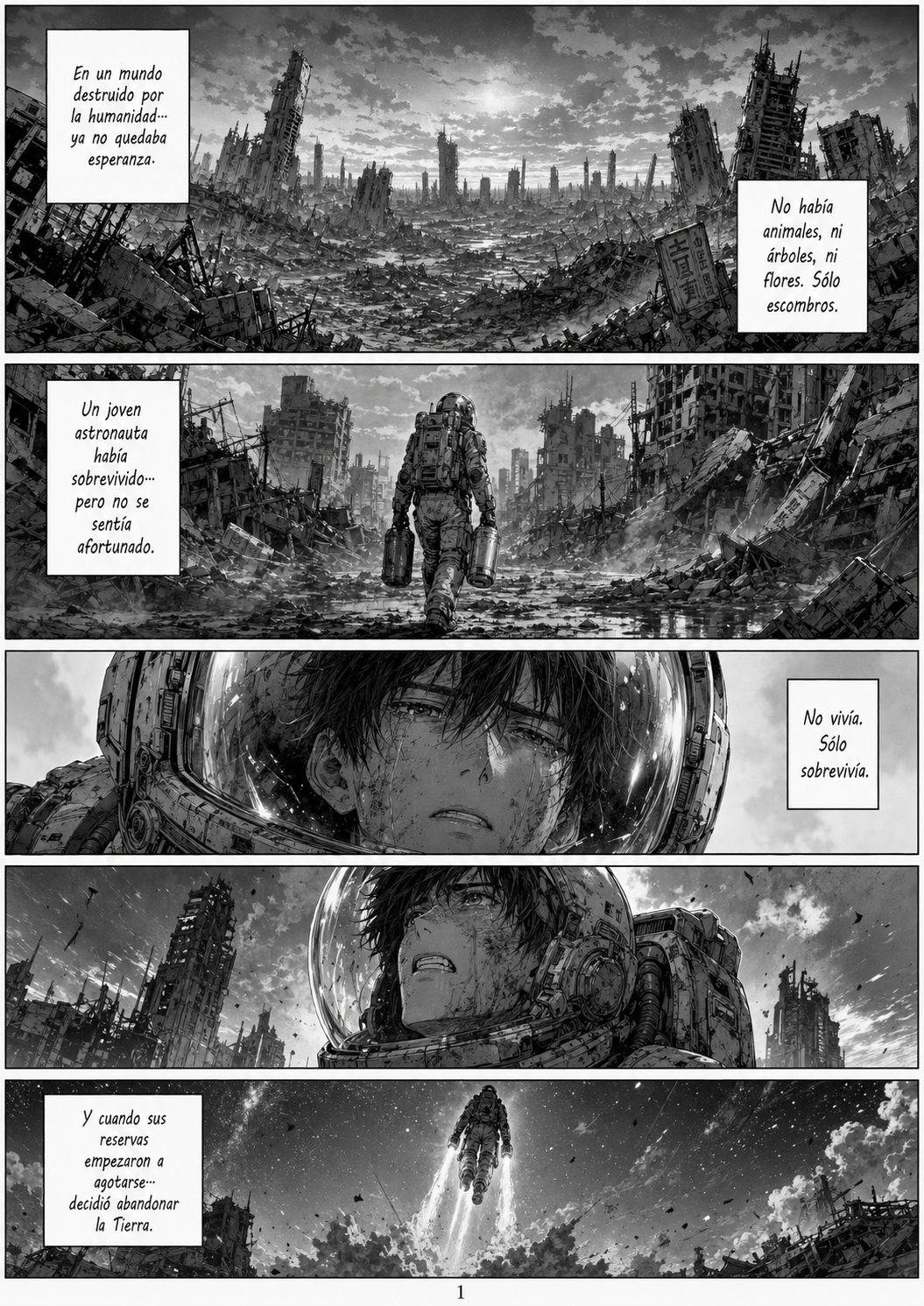
In a world where nothing we know was left, completely destroyed by humanity, hope no longer existed. Planet Earth had lost all of its species; there were no more animals, no trees, and not even flowers existed. All that remained was the rubble of what had once been a civilization that brought everything to ruin through its extreme selfishness.
And yet, a young man had managed to survive. Was he immune to everything? Was he special? He could even fly at great speed; he was an astronaut who, since the collapse of the world, had never been able to take off his suit again. Still, he did not consider himself fortunate — on the contrary, to him it was a misfortune to live among the waste left of what had once been his home. He lived desolately, walking the world with his reserves of water and oxygen. No. He did not live, he survived, and his days, without motivation, grew heavier and heavier.
Since his reserves would not last forever, he decided to abandon planet Earth, a place that filled him with extreme rage and sadness. He preferred to die in the beyond, in space.
He began to fly, adrift, finding nothing, and little by little his hopes faded more and more.
When he could no longer bear the hopelessness and uncertainty, he finally decided to remove his helmet and tight suit to put an end to his suffering. However, in the distance he saw something faintly shining, by pure chance; it caught his attention, and for the last time, he decided to see what it was.
When he saw it, he didn't know if he was hallucinating or imagining things. His eyes welled up with emotion: it was a poor, small, half-wilted flower that was still alive. But how? What was a flower doing in space? It had been so many years since he had seen the last one on planet Earth. It was a red rose that kept losing more of its colors and its life, and it too was adrift, like him. But even wilted and barely alive, he was captivated by the beauty of seeing a flower again when none existed on the face of the Earth.
The astronaut thought about how he could help it; it was the only thing he wanted, it had become his motivation. Before dying, he wanted to be able to help the flower; he thought about how he could give it life again. The first thing he tried was to give it his water reserves — he didn't need to take off his suit to do so. Its glow and color improved a little, but it still seemed lifeless, and where they were there was no sunlight to illuminate it.
He knew what he had to do: he had to bring it to Earth somehow, even if it cost him his life. His oxygen reserves were getting lower and lower, and he worried about not making it in time.
He held the flower delicately and protected it while flying as fast as possible toward Earth. During the flight, the astronaut never stopped asking himself questions. How had the flower gotten there? How had it stayed alive for so long amid so much adversity? The flights seemed fast but lasted days relative to Earth's time, so he felt more and more attachment to the flower, which he cared for with all his being. He even came to think that he loved it, because he had never felt anything like that for anything or anyone else. He wished he could talk to it, know its story, get to know it, but clearly that was impossible, and that saddened him — but it didn't matter, because he didn't need it, he only loved it.
As he approached Earth, he began to notice that the flower was wilting more and more. The astronaut panicked; he didn't understand why, then he realized that Earth's oxygen was extremely toxic, even for the flower.
When he landed and saw it dying, he couldn't bear it; he couldn't bear to lose the only thing that had given him so much happiness and hope, even if it had been for a brief time. He believed that at least, for one last time, the rose needed to and had to bloom.
Now he had sunlight and the water reserves; he only lacked pure oxygen.
Without hesitation, the astronaut removed his oxygen helmet and placed it over the flower. The cost was his death. As he watched the sunset and felt the deadly wind's breeze on his face after so, so many years, his hair moved, and his hands felt the warmth of the rose for one last time. He felt peace after so long, but he was already doomed. He enclosed the rose in the glass of his helmet, praying for the hope of seeing it bloom thanks to the remaining oxygen, but it wasn't enough — it couldn't bloom.
The astronaut lay down on the ground awaiting his death; he embraced with all his love and affection the transparent helmet enveloping the flower, with tears on his face, because all his attempts to help it had been in vain and he couldn't even save the only thing he had ever loved in his life… but then, in that moment, little by little the rose took shape, its petals became firm and opened more and more, its color turned the most intense and brilliant red — it had managed to bloom. What was missing for it to bloom? It wasn't just the sun, the water, or the oxygen; it was the astronaut's love.
His eyes slowly closed as he breathed the toxic oxygen, but even in his death, it was his happiest moment: to see what he loved most bloom, what he had cared for most in his life. As his eyes closed, they welled up with emotion, and he touched the glass that separated him from the most beautiful and unique flower he had ever seen. He wished he could touch it one last time in its most beautiful state, but he only protected the glass so it could live as long as possible. But to his astonishment, the glass began to break little by little; he got scared, it wasn't possible — what was happening? The helmet shattered completely. Could it be the flower that wanted this and was doing it? And amid the shine of the glass and the sunset, the rose fell into his hand. The astronaut smiled because he knew the flower wanted the same thing: to be by his side; it loved him too. He touched its petals in their most beautiful state as they once again began to wilt. They both faded and died together, and in his last breath, he embraced the flower with all his strength as it shed its petals, which flew away with the breeze of the wind.
We can survive for a long time, but the only way to truly LIVE is to find love.
Dedicated to you, Toti, my astronaut.